Guides/Design·8 min read·Updated September 4, 2026
A well-wrapped tree looks lit from the trunk to the tips of its branches, evenly and without visible wire. Here is how professional crews approach the job on trees of every size.
Key takeaways
- 1Trunk wrapping and branch wrapping use different techniques, and a natural-looking result usually needs both done well.
- 2Even spacing and consistent colour temperature matter more to the finished look than the sheer number of lights used.
- 3Mature trees over roughly 20 to 25 feet generally need a boom truck or aerial lift to wrap safely and completely rather than relying on a ladder or pole.
- 4Commercial-grade LED strands and weatherproof connections hold up through an entire season of wind and precipitation better than consumer-grade lights.
- 5A tree that is professionally wrapped and stored properly over summer can often be relit for several seasons before a full re-wrap is needed.
A mature maple or spruce wrapped properly in warm white lights is one of the most recognizable images of the holiday season, and it is also one of the more technically demanding parts of a lighting installation. Unlike a roofline, which is a fixed, mostly straight surface, a tree is a three-dimensional, irregular shape that changes from trunk to canopy, and every branch has its own angle and thickness. Wrapping it so the lights read evenly from every direction, without visible bare wire or clumped bulbs, is a skill that professional crews develop over many seasons.
Trunk wrapping versus branch wrapping
The trunk and the branches are wrapped differently because they serve different visual purposes. Trunk wrapping spirals the light strand tightly around the trunk from the base up to where the first major branches begin, creating a continuous glowing column that anchors the whole display and gives the tree a defined base even in daylight, when the bulbs are visible but not lit. Branch wrapping extends that spiral out along each major limb, following the branch's natural angle rather than running straight, so the light traces the shape of the tree instead of cutting across it in an unnatural line.
Getting the spiral tension right on both trunk and branch matters more than it might seem. Wrapped too loosely, the strand sags and the bulb spacing looks uneven from a distance. Wrapped too tightly, the wire can bite into the bark as the tree grows and moves in the wind over the following months, especially on younger trees with thinner bark. Professional crews aim for a snug spiral that sits close to the surface without pulling, checked by eye and by hand as they go rather than judged from measurements alone.
Spiral angle and how it changes along a branch
The angle of the spiral itself typically tightens as a branch narrows toward its tip. A wider angle near the base of a thick limb covers more surface with fewer coils, while a tighter spiral near the branch tip keeps the same visual density even as the branch has less surface to wrap. Applying one fixed spiral angle across a branch's entire length, from thick base to thin tip, is a common reason a DIY wrap looks reasonably even near the trunk but sparse and stretched out toward the ends.
Why even spacing matters more than density
It is tempting to think a denser wrap, meaning more strands packed onto the same tree, automatically looks better. In practice, even spacing along the length of every branch does more for the finished look than raw bulb count. A tree wrapped with a light, evenly spaced hand reads as glowing from every angle, while a tree with lights bunched near the trunk and thinning out toward the branch tips looks unfinished no matter how many total bulbs were used. Professional installers work outward from the trunk in sections, keeping the spacing between coils consistent as the branch narrows, rather than measuring out a fixed length of light per branch and hoping the spacing works out.
Colour temperature and why consistency counts
Warm white is by far the most common choice for a wrapped tree because it reads as a classic, cohesive glow rather than a cooler, more clinical white. The detail that matters here is consistency: every strand used on a single tree needs to be the same colour temperature, from the same product line if possible, because even a subtle shift between a warmer and a slightly cooler white becomes obvious once the whole tree is lit at night. Mixing leftover strands from different seasons or different manufacturers is one of the more common ways a DIY tree wrap ends up looking patchy despite an even physical spacing.
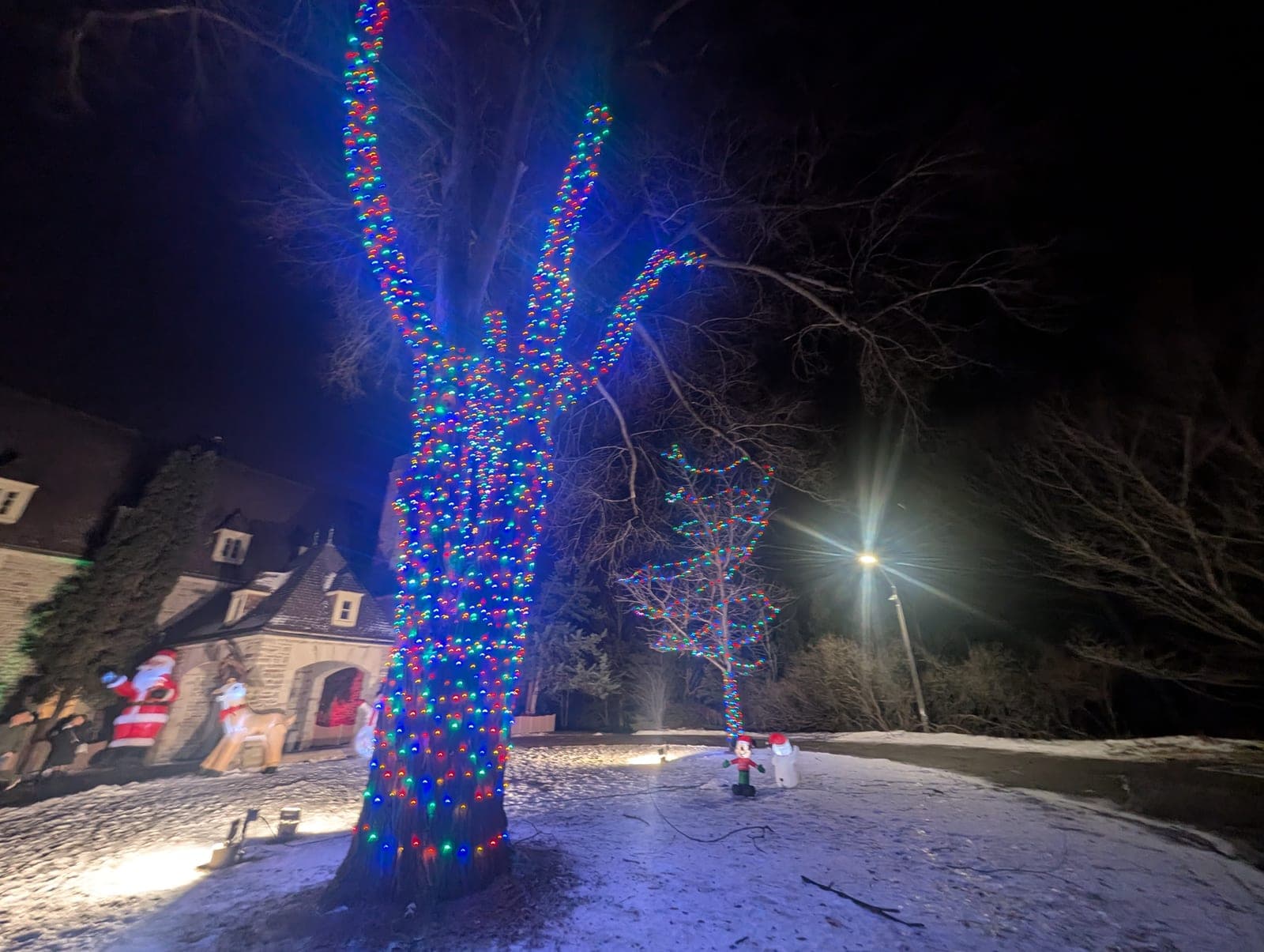
Some properties choose a coloured accent rather than pure warm white, particularly for a single feature tree near an entrance or a commercial sign. Where colour is used, the same consistency rule applies: a mix of colour and warm white strands on one tree needs a deliberate pattern, whether that is alternating branches or a colour-tipped canopy over a warm white trunk, rather than a random mix that reads as mismatched rather than intentional.
Reaching the top of a mature tree safely
This is where tree wrapping stops being a ladder job. A young ornamental tree in a front yard might be wrapped comfortably from the ground and a short stepladder, but a mature oak, maple or spruce, often 25, 35 or more feet tall, has canopy that no ladder can reach safely, and climbing the tree itself to place lights is not a safe or acceptable method. This is exactly the situation JLG and Genie boom trucks and lifts are built for. Festive Holiday Lighting uses this equipment specifically to reach the upper canopy of tall trees, allowing the wrap to continue evenly all the way to the crown instead of stopping partway up where a ladder runs out of reach.
Working from a lift also changes how the wrap gets done. Instead of working from the ground and tossing or looping strands up into the canopy, which tends to produce an uneven, clumped result on anything taller than a small tree, a crew working from an aerial platform can wrap each branch by hand at the height it actually grows, keeping the spacing and tension consistent from trunk to tip. For very tall or architecturally significant trees, this is often the difference between a wrap that looks finished and one that visibly gives up two-thirds of the way up.
Materials that hold up through the whole season
A tree wrap sits outside from install in November through takedown after January 6, exposed to wind, rain, ice and freeze-thaw cycles the whole time. Commercial-grade LED strands with sealed, weatherproof connections are built for that exposure, while consumer-grade string lights are more prone to individual bulb failure and connection corrosion over the same stretch of time. On a tall, densely wrapped tree, a failed section partway up the canopy is difficult to spot and even more difficult to fix without bringing lift equipment back out, so starting with commercial-grade materials matters more here than on almost any other part of a display.
Garland, mesh and alternatives to a full wrap
Not every tree needs a full spiral wrap to look finished. Smaller ornamental trees near an entrance sometimes work well with pre-lit garland woven through the branches instead, and some installers use light netting or mesh draped over a tree's canopy as a faster alternative to hand-wrapping, though the result reads differently, more like an even glow over the surface than a defined branch structure. For most mature shade trees, a proper hand wrap of trunk and branches remains the technique that produces the most natural, three-dimensional result, and it is the approach used on most of our residential and commercial tree lighting projects.
Takedown and re-lighting in future seasons
Removing a full tree wrap uses the same access equipment as the install, since the top of the canopy has to be reached again to unwind the strands cleanly rather than pulling from the ground and risking damage to branches or bark. Lights removed carefully and stored properly over the summer, coiled rather than balled up, and kept out of extreme heat, can often be reused for a few seasons before individual strands start to fail and need replacing. Trees that are wrapped and maintained by the same installer year after year also tend to need less time on the return visit, since the crew already knows the tree's shape and branch structure from the previous season.
It is worth noting that a tree's shape does change year to year as it grows, particularly a younger tree still filling out its canopy. A wrap that fit a tree's structure perfectly two seasons ago may need small adjustments, an extra section of strand on a branch that has extended, or a slightly different spiral on a limb that has thickened, rather than an identical repeat of the previous year's layout. This is one more reason a full re-check at install time, rather than simply reapplying the same lights from storage without a fresh look at the tree, produces a better result over the years.
Getting a tree lighting quote
Whether it is a single feature tree at a home entrance, a mature shade tree in a front yard, or a signature tree for a commercial property or town centre event, tree wrapping is quoted individually based on the tree's height, canopy size and access requirements. Quotes are free for homeowners and businesses across Hamilton, Burlington, Oakville, Mississauga, Brampton and the surrounding Southern Ontario area. More on our approach to feature and commercial tree lighting is at /services/tree-lighting, or reach out through /contact or by calling (289) 426-5764.
Frequently asked questions
How tall does a tree need to be before a ladder is not enough?
It varies with the tree's shape, but mature trees roughly 20 to 25 feet and taller generally need a boom truck or aerial lift to wrap completely and safely, since the upper canopy sits beyond what a ladder can reach.
Why does colour temperature consistency matter so much on a wrapped tree?
Once an entire tree is lit at night, even a subtle difference in warm white shade between strands becomes visible and reads as patchy. Using matched strands from a single product line avoids this.
Is a denser wrap always better looking than a lighter one?
Not necessarily. Even, consistent spacing along every branch tends to matter more to the finished look than raw bulb count, since a tree with lights bunched near the trunk and thinning toward the tips looks unfinished regardless of how many total lights were used.
Can lights stay on a tree from one season to the next?
Generally no, since seasonal wraps are removed after the holiday season, typically after January 6, and stored properly for reuse. Leaving commercial holiday lighting up year-round is really a different service, closer to permanent lighting, which uses purpose-built fixtures rather than seasonal strands.
Does wrapping a tree tightly damage it?
A properly tensioned wrap sits snugly against the bark without pulling, and should not damage a healthy tree over one season. Wrapping too tightly, especially on younger trees, can be a concern if the wire is left on too long or the tree grows significantly during the wrap period.
Can garland be used on a tree instead of a full light wrap?
Yes, particularly for smaller ornamental trees near an entrance, where pre-lit garland woven through the branches can look finished without the scale of a full hand wrap used on a mature shade tree.
Free quote
Want us to just handle it?
Send a photo of the house and we'll come back with a price within a day.
Keep reading
Design · 8 min
C9 Bulbs vs Mini Lights vs Icicles: Choosing a Look for Your Home
The bulb style you choose changes the entire character of a Christmas display. Here is how C9 bulbs, mini lights and icicles differ, and which suits which kind of home.
Design · 8 min
Warm White vs Multicolour vs RGB: Picking a Colour Scheme
Warm white, multicolour and RGB all read differently on a rooftop, and the right choice depends on your home's exterior, your street and whether you want a fixed seasonal look or year-round colour control.
Design · 8 min
Holiday Lighting Design Ideas for Brick and Stone Homes
Brick and stone facades call for different colour, mounting and placement decisions than vinyl siding. Here is how to plan a roofline-to-garden lighting design that suits masonry homes across Hamilton, Burlington and Oakville.