Guides/Planning·8 min read·Updated September 4, 2026
Falls, ice and outdoor electrical hazards send more people to the emergency room every November and December than most homeowners expect. Here is what actually goes wrong, and why insured, trained crews matter.
Key takeaways
- 1Ladder falls are one of the most common causes of holiday-season emergency room visits, and rooflines get more dangerous, not less, once temperatures drop and frost or ice forms.
- 2Wet or icy roofing material can be hazardous even for someone experienced on ladders, since footing and grip both change once the surface temperature drops.
- 3Overloaded outdoor circuits and worn extension cords are a common source of electrical hazards and fires around holiday lighting.
- 4Liability insurance protects a homeowner or business from being financially responsible if a worker is injured or property is damaged during installation.
- 5WSIB compliance means a crew's own injury coverage does not become the homeowner's or property owner's problem if something goes wrong on site.
Every December, local news carries at least one story about a homeowner falling from a ladder while trying to hang Christmas lights, and emergency rooms across the country see a real, measurable increase in fall-related injuries in the weeks leading up to the holidays. Climbing onto a roof or up a tall ladder in November and December is a different task than doing the same climb in July, and the reasons why are worth understanding whether you are doing the work yourself or hiring someone else to do it.
Why late-season rooflines are more dangerous than they look
By the time most people are hanging Christmas lights, overnight temperatures in Southern Ontario are regularly at or below freezing, and roofing material behaves differently in the cold. Asphalt shingles that grip a boot sole reasonably well in warm weather become stiffer and less grippy as the temperature drops, and any morning dew, light rain or frost that has not fully burned off leaves an invisible slick layer on top of that. A roof surface that felt secure during a summer maintenance check can feel completely different in late November, and the change is easy to underestimate because nothing about the roof itself has changed, only the weather.
Ice is the more obvious hazard, but frost is arguably more dangerous because it is harder to see. A light overnight frost on a north-facing roofline or shaded eave can persist well into the morning even on a day that otherwise looks clear, and it is thin enough that it is not always visible from the ground before someone climbs up. Steep or metal rooflines are particularly unforgiving once any moisture or frost is present, since there is little texture to begin with even in dry conditions.
Wind is a factor that gets overlooked as often as ice. Late fall and early winter in Southern Ontario regularly bring gusty days, and wind load on a ladder or on a person's balance increases significantly the higher they climb. A gust that would be a minor annoyance at ground level can be enough to shift a ladder's position or throw off someone's balance while they are reaching to secure a strand, which is one more reason experienced crews check the forecast before scheduling roof or tree work rather than pushing through regardless of conditions.
Ladders: the most common source of injury
Most Christmas light injuries do not actually involve falling off a roof. They involve falling off a ladder while working near a roofline, often while reaching sideways to clip a strand to a gutter or fascia board just out of comfortable reach. Overreaching from a ladder shifts a person's centre of balance outside the ladder's base, and on soft late-fall ground, a ladder's feet can also sink or shift slightly under load in a way that is not obvious until it happens. Extension ladders used at the height needed to reach a two-storey roofline carry real fall risk even for someone experienced with them, which is part of why professional crews use fall protection and, on taller or more complex buildings, aerial lift equipment instead of ladders altogether.
Electrical hazards hiding in a normal setup
The electrical side of holiday lighting causes fewer dramatic headlines than a ladder fall, but it is a real and common hazard. Outdoor extension cords left out season after season degrade from UV exposure and repeated freeze-thaw cycles, and cracked insulation on an old cord is a shock and fire risk that is easy to miss in the dark. Plugging too many light strands into a single outdoor outlet or power bar, especially older incandescent strands that draw more current than modern LEDs, can overload a circuit and cause overheating at the connection point, sometimes without tripping a breaker until real damage has already been done. Even with LED lighting, which draws far less power than older incandescent sets, connections still need to be properly rated for outdoor use and protected from standing water, which is where commercial-grade, sealed connectors matter.
Ground-fault protection is another detail that gets overlooked on an older home or a commercial building with aging exterior outlets. Any outdoor circuit used for holiday lighting should be protected by a ground-fault circuit interrupter, and it is worth testing that the outlet's test button actually trips the circuit before relying on it for the season, since a GFCI outlet that has failed silently no longer offers the protection it appears to.
What professional training actually changes
A trained crew is not simply more comfortable on a ladder or roof, they approach the job differently from the start. That means checking weather and surface conditions before climbing rather than assuming yesterday's dry roof is still dry today, using proper fall protection and, where needed, boom trucks or aerial lifts instead of stretching a ladder to its limit, and following a consistent process for securing extension cords, sizing circuits correctly and sealing every outdoor connection against moisture. Ten years of doing this work across thousands of rooflines also builds a working sense for which houses, trees and commercial buildings actually need lift equipment rather than a ladder, a judgment call that matters more to overall safety than any single piece of gear.
Why liability insurance is not just paperwork
If a worker is injured while installing lights on your property, or a piece of equipment damages your roof, siding or landscaping during the job, liability insurance is what determines whether that becomes the installer's problem or yours. A contractor without adequate liability coverage puts the property owner at real financial risk if anything goes wrong, since a homeowner's own policy is not designed to cover injuries to someone else's employee working on their property. Festive Holiday Lighting carries five million dollars in liability insurance specifically so that risk sits where it belongs, with the company doing the work, not with the homeowner or business that hired them.
WSIB compliance: coverage for the crew, protection for you
WSIB compliance is a separate but related protection. It means the people doing the physical work, climbing ladders, operating lift equipment, or working at height on a roofline, are covered for workplace injury through Ontario's workplace safety insurance system. Without that coverage, an injured worker could potentially pursue the property owner directly for costs related to an on-site injury, which is a liability most homeowners and businesses have no reason to expose themselves to for what should be a straightforward seasonal service. A WSIB-compliant crew keeps that responsibility where it belongs, with the employer.
Why aerial equipment is a safety choice, not just a convenience
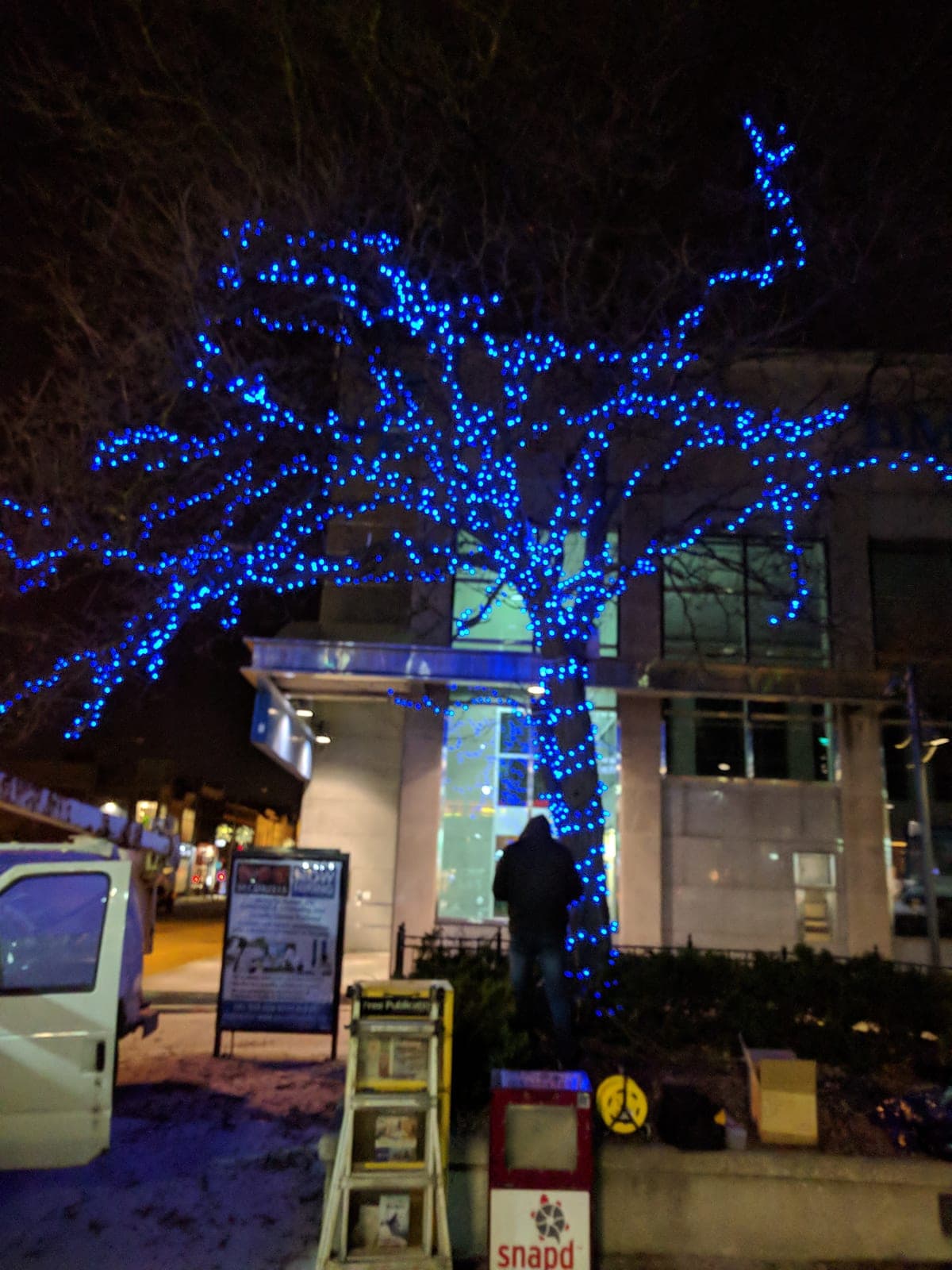
Boom trucks and aerial lifts often get talked about in terms of what they make possible, reaching a mature tree's upper canopy or a hotel's fourth-storey facade, but their real value is safety. A platform lift keeps a worker on stable, level footing at height, with guardrails, rather than balanced on a ladder rung reaching sideways toward a gutter. Festive Holiday Lighting uses JLG and Genie boom trucks and lifts for exactly this reason on tall trees and multi-storey commercial buildings, where a ladder-based approach would mean either an incomplete job or an unacceptable level of risk to the crew.
What this means if you are deciding between DIY and hiring a professional
None of this is meant to suggest a homeowner cannot safely hang lights on a single-storey, low-pitched roofline with reasonable care and dry conditions. It is meant to explain why a steep roof, a tall tree, a multi-storey commercial building, or any job where conditions are uncertain is a different calculation. If a job requires height beyond what a standard extension ladder safely reaches, or the roofline is steep, icy or wet, the risk profile changes enough that professional equipment, training and insurance stop being a luxury and start being the actual difference between a job done safely and one that ends in an emergency room visit or a liability dispute.
Age and physical comfort with heights are also worth an honest self-assessment. A ladder task that felt routine at thirty can carry meaningfully more risk at sixty, not because of any single dramatic factor but because balance, grip strength and reaction time all shift gradually over the years. There is no reason to treat hiring a professional crew as an admission of anything other than good judgment about where a particular job sits on the risk scale.
Getting a quote with safety built in
Every quote from Festive Holiday Lighting factors in the access equipment and crew approach a specific property actually needs, whether that is straightforward ladder work on a single-storey home or a boom truck for a mature tree or commercial facade. Quotes are free for homeowners and businesses across Hamilton, Burlington, Oakville, Mississauga, Brampton, Milton, Ancaster, Grimsby, St. Catharines and Niagara Falls. Reach out through /contact or call (289) 426-5764 to talk through what your property needs before deciding how the job gets done.
Frequently asked questions
Why are Christmas light injuries more common than people expect?
Cold weather changes how rooflines and ladders behave. Frost, dew and near-freezing temperatures reduce grip and footing in ways that are easy to underestimate, and reaching sideways from a ladder to clip lights is a common cause of falls.
Is frost really as dangerous as ice on a roof?
It can be more dangerous in practice, since frost is thinner and harder to see from the ground than visible ice, and it can persist on shaded or north-facing sections of a roof well into the morning.
What should I ask a lighting contractor about safety before hiring them?
It is reasonable to ask whether they carry liability insurance, whether their crew is WSIB compliant, and what equipment they use for taller buildings or trees. A legitimate, experienced contractor will answer these directly.
What does liability insurance actually protect me from?
It covers injury to workers or damage to your property that happens during the job, so that responsibility sits with the contractor's insurance rather than becoming a financial or legal issue for the homeowner or business that hired them.
Why does WSIB compliance matter if I am just hiring someone for a day?
Without WSIB coverage, a worker injured on your property during the job could potentially seek costs directly from you as the property owner. A WSIB-compliant crew keeps that risk with the employer, where it belongs.
Do I need a professional for a simple single-storey house?
Not necessarily. A low, single-storey roofline in dry conditions is a reasonable DIY job for someone comfortable on a ladder. The risk profile changes significantly on steep, tall, icy or multi-storey properties, which is where professional equipment and insurance matter most.
Free quote
Want us to just handle it?
Send a photo of the house and we'll come back with a price within a day.
Keep reading
Planning · 7 min
When to Book Christmas Light Installation (and Why September Matters)
The best-looking Christmas displays are rarely the result of a last-minute call. Here is how the seasonal booking calendar actually works and why late September is the smart cutoff.
Planning · 8 min
What Happens After the Season: Takedown, Storage and Next Year
Booking a professional installer means the lights come down, get inspected and are stored without you lifting a ladder. Here is what actually happens after Twelfth Night, and what to expect heading into next season.
Costs · 8 min
How Much Does Professional Christmas Light Installation Cost in Ontario?
Every quote for professional Christmas light installation is different because every roofline, tree count and product mix is different. Here is what actually moves the price.